

 By Hamad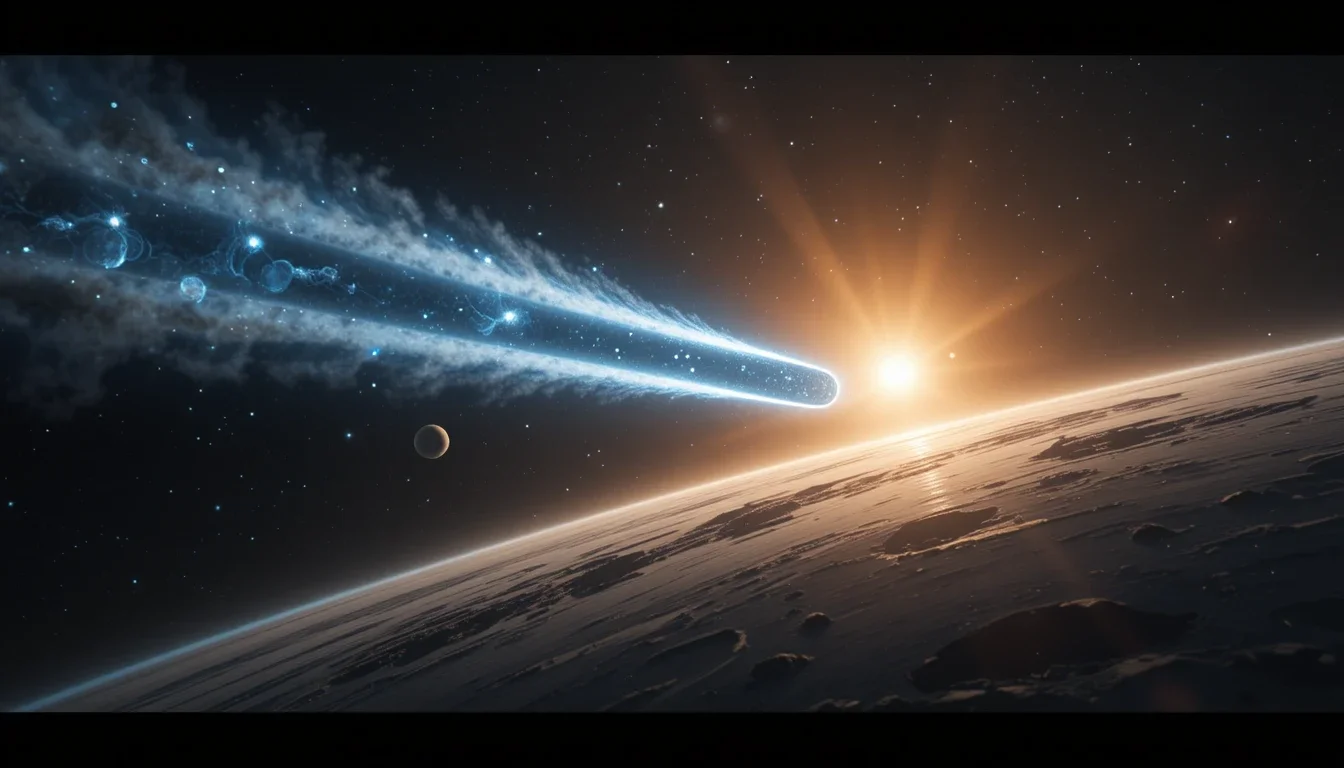
A Special Visitor: Interstellar Comet 3I/ATLAS
Our solar system has been visited by a new guest from deep space: Interstellar Comet 3I/ATLAS. This is only the third confirmed object we’ve ever seen that didn’t originate in our own star system, following ‘Oumuamua (2017) and 2I/Borisov (2019).
Think of our solar system as a house. This comet isn’t from the neighborhood; it’s a piece of material that was kicked out of another star system a very long time ago. Its visit is a rare and precious event that gives scientists a “free sample” of what matter looks like in other parts of the Milky Way galaxy.
The name “3I/ATLAS” simply means it is the 3rd Interstellar object (3I) discovered, and it was first spotted by the ATLAS telescope in Chile. It was found in July 2025, near Jupiter, and is currently making its pass through our solar system before it disappears forever.
How Fast Is This Comet Moving?
The speed of 3I/ATLAS is hard to imagine. It is traveling at an incredible pace of 42 miles per second.
To put this speed in perspective:
- The fastest car on a highway moves at about 0.02 miles per second.
- The speed of sound is about 0.21 miles per second.
This comet is moving at roughly 200 times the speed of sound, making it one of the fastest natural objects ever recorded near the Sun.
Because it is moving so fast and is not stuck in the Sun’s gravity, the comet follows a hyperbolic trajectory—a fancy way of saying its path is an open curve. It will fly by once, and then its journey will take it out of our solar system and back into the space between the stars.
What Scientists Hope to Discover– Interstellar Comet 3I Atlas
The main goal is to use 3I/ATLAS as a time capsule. By studying the dust, gas, ice, and minerals that the comet releases, scientists hope to answer huge questions about the universe.
As Dr. Aidan Berres, an astronomy researcher, put it, studying the comet could offer clues about the “early chemistry of the universe.”
1. The Birth of Other Worlds
Every comet is made of the raw materials left over from when a star and its planets were forming. By analyzing the chemicals in 3I/ATLAS, scientists can understand:
- How planets and stars form around other suns.
- The chemical recipe used to create other solar systems. Are they similar to ours, or wildly different?
- Whether organic compounds (the building blocks of life) exist far outside our home star system.
2. The Origins of Our Solar System
Understanding other star systems actually helps us understand our own. If 3I/ATLAS shares chemical similarities with the comets and asteroids in our solar system, it suggests that planet formation follows the same basic rules across the galaxy. If it looks completely different, it shows that unique processes shaped our solar system.
The Challenge of Observation
Even though 3I/ATLAS is a major event, getting a good look at it is incredibly difficult.
Spacecraft Tracking
Several space agencies are trying to observe the comet from a safe distance.
- The European Space Agency (ESA) used its ExoMars Trace Gas Orbiter and Mars Express to capture images of the comet’s coma (the bright cloud of gas and dust surrounding its core).
- ESA noted that taking these pictures was like trying to “see a mobile phone on the Moon from Earth”—a testament to how distant and small the comet is.
Missed Intercept Opportunity
Unfortunately, no spacecraft was ready to meet the comet up close. Experts, like astronomy student Atsuhiro Yaginuma, confirmed that while a fly-by mission was technically possible if prepared in advance, it’s too late now.
However, this research isn’t wasted. ESA’s planned Comet Interceptor mission, set to launch in 2029, will be waiting in space, ready to chase down the next interstellar visitor that comes our way.
The Future of Finding Cosmic Travelers – Interstellar Comet 3I Atlas
Finding objects like 3I/ATLAS is only possible through highly advanced technology.
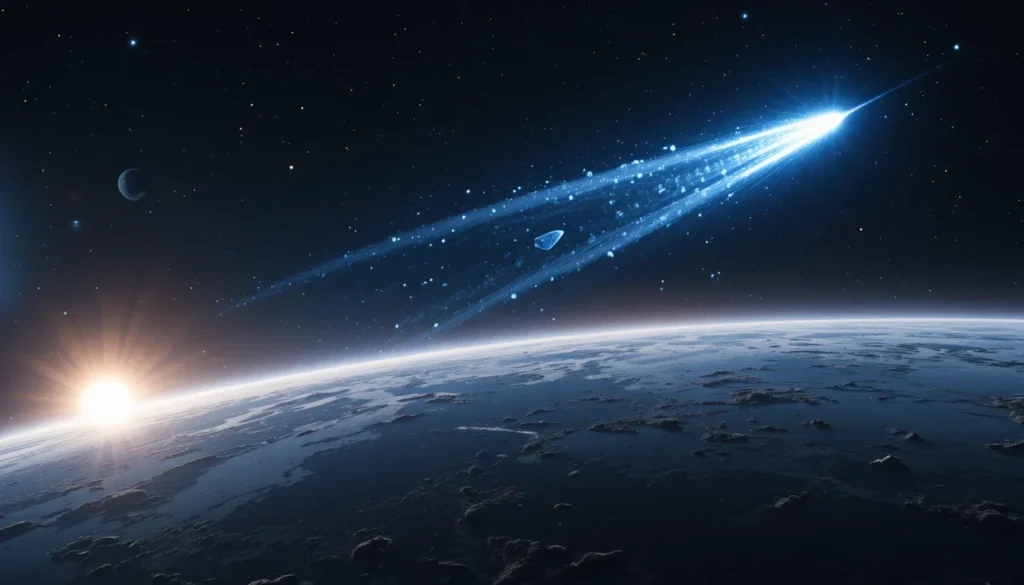
- ATLAS (the telescope system that found it) is one of several automated systems that constantly scan the sky for fast-moving objects.
- Upcoming projects like the Vera C. Rubin Observatory in Chile will use powerful cameras and AI (Artificial Intelligence) to scan huge parts of the sky over many years. This system will be much better at flagging new cosmic visitors than humans could ever be.
Dispelling the “Alien” Theory
As often happens with strange space objects, some people have suggested that 3I/ATLAS is actually alien technology. While the comet’s chemistry is fascinatingly odd, experts like NASA and other astronomers have firmly dismissed these theories. The consensus is that 3I/ATLAS is a natural comet. Its strange chemistry simply makes it a very exciting scientific discovery—not a piece of alien equipment.
What’s Next for 3I/ATLAS?
The comet reached its closest point to the Sun (called perihelion) around the end of October 2025. It is now on its way out.
- December 2025: It will still be visible from Earth using strong telescopes.
- March 2026: It will fly past Jupiter.
- July 2026: It will pass Saturn and become too dim to be tracked by our current telescopes.
After that, this unique piece of another star system will travel into the emptiness of interstellar space, carrying its secrets with it. The data gathered from its short visit will continue to be analyzed for years, giving scientists a new window into the vast and varied chemistry of the universe.
